
A Ukrainian Engineer Wrote a Note to Himself on December 17, 2018. It Became a $160 Million Business That America Can’t Stop Using.

In February 2022, Anton Pavlovsky was in London when Russia launched its full-scale invasion of Ukraine.
Most people were trying to get out. He got on a plane back in.
His team was in Kyiv. His company — a book summary app he’d built with three people in 2019 — was three years old, bootstrapped, and about to face something no business plan accounts for: a war in the country where all your employees live.
He helped relocate the people who needed to leave. Then he went back to the Kyiv office and kept working.
What happened next is either the most counterintuitive startup story of the decade, or the most logical one depending on how you look at it. Revenue grew 90% that year. The year of the invasion.
By 2025, Headway had $160 million in annual revenue, 150 million users across 170 countries, a Series A led by Bullhound Capital — their first external funding in six years — and a spot on TIME magazine’s list of the world’s top four EdTech companies.
All of it, on essentially no outside capital. Until last year.
The note Anton wrote to himself on December 17, 2018 is still on his phone.

He’d stopped reading. Not because he didn’t love books — he’d grown up loving them — but because modern life had made it impossible to justify the time. Ukraine’s turbulent decades. Work. The relentless pace of staying informed about everything while actually absorbing nothing.
So he wrote down what he would build if he could build anything: “A platform that allowed individuals to educate themselves, educate others, be a role model. A platform that will spread enlightenment.”
Three weeks later, Headway launched.
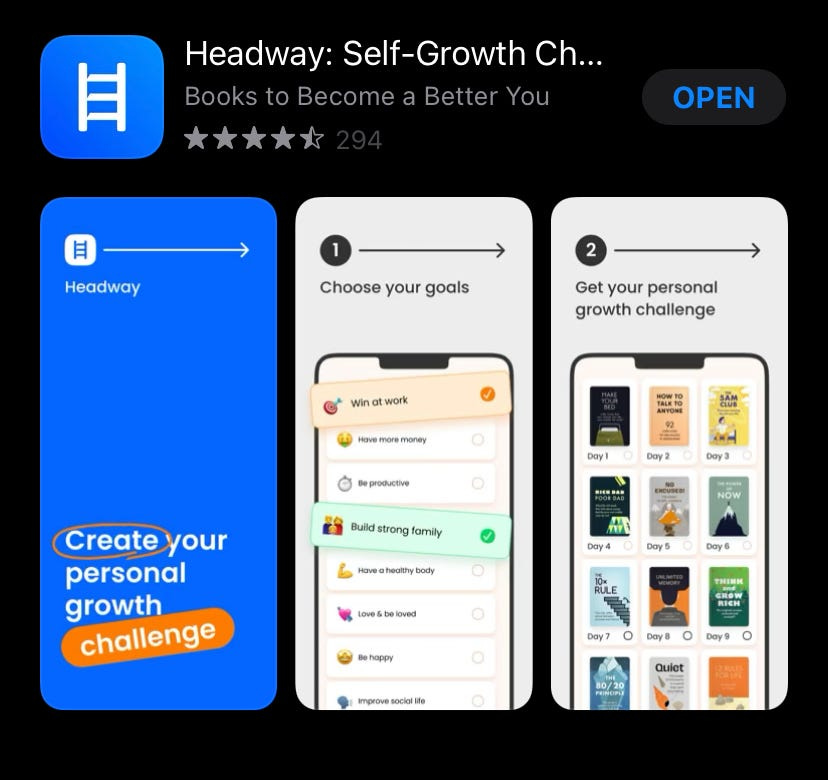
The premise was almost embarrassingly simple: take a 400-page non-fiction book, extract the ideas that actually matter, and deliver them in 15 minutes of reading or audio. Not a replacement for books. A filter for the ones worth reading — and a way back in for the 46% of American adults who, by 2023, had finished zero books that year.
The category wasn’t new. Blinkist had been doing book summaries since 2012. GetAbstract before that. What Anton understood was that the product wasn’t really about books at all.
It was about guilt.
Every professional who isn’t reading carries a quiet version of the same feeling: I should be learning more. I’m falling behind. There’s a stack of books on my nightstand I’ll never get to.
Headway didn’t sell book summaries. It sold the end of that feeling.
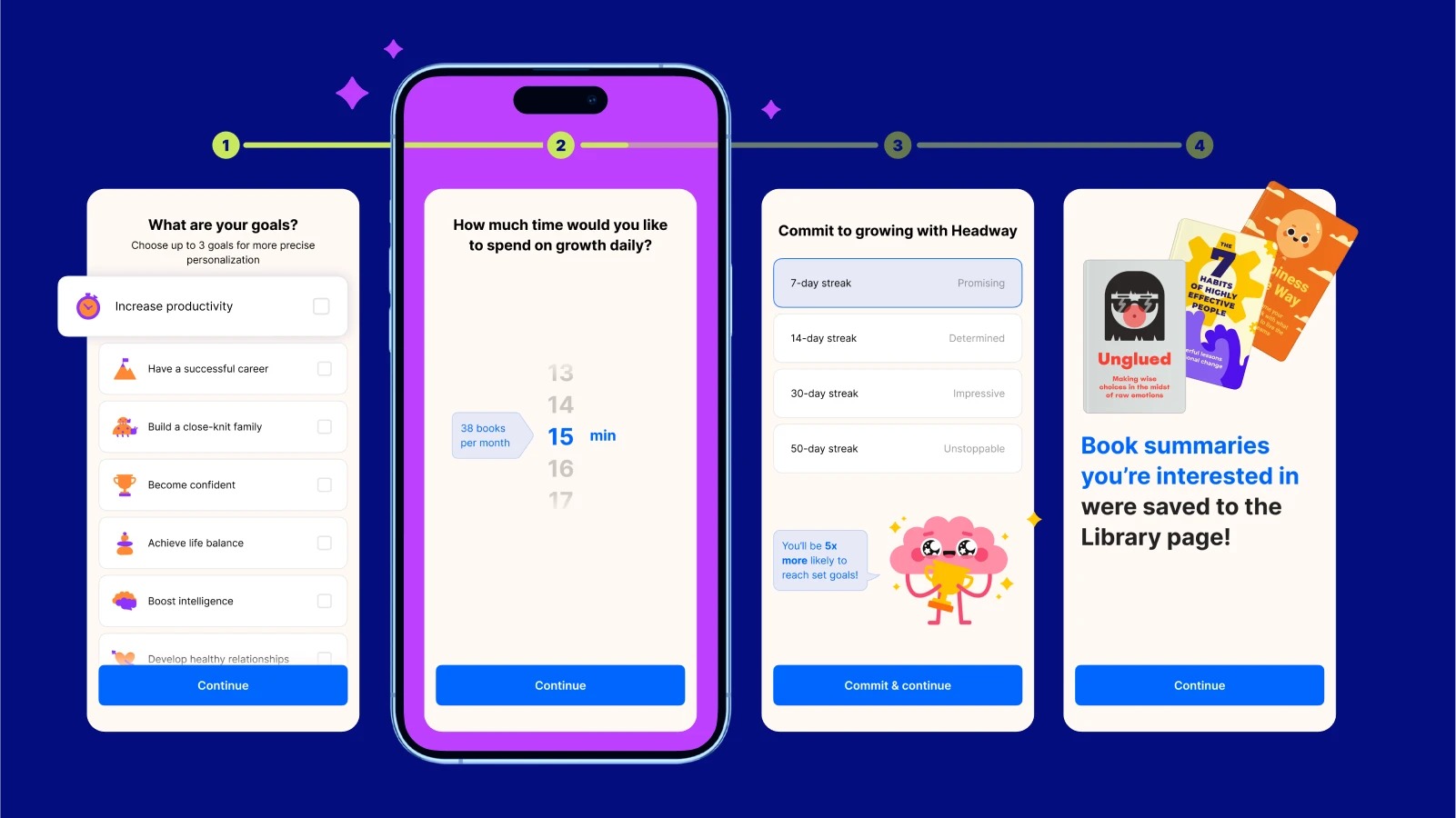
The UX was built entirely around this insight. When you open the app and tell it you have 20 minutes a day, it calculates that you can get through 51 books a year in that window. Not “some books.” Fifty-one. That number does something specific to the person who has been telling themselves they don’t have time to read.
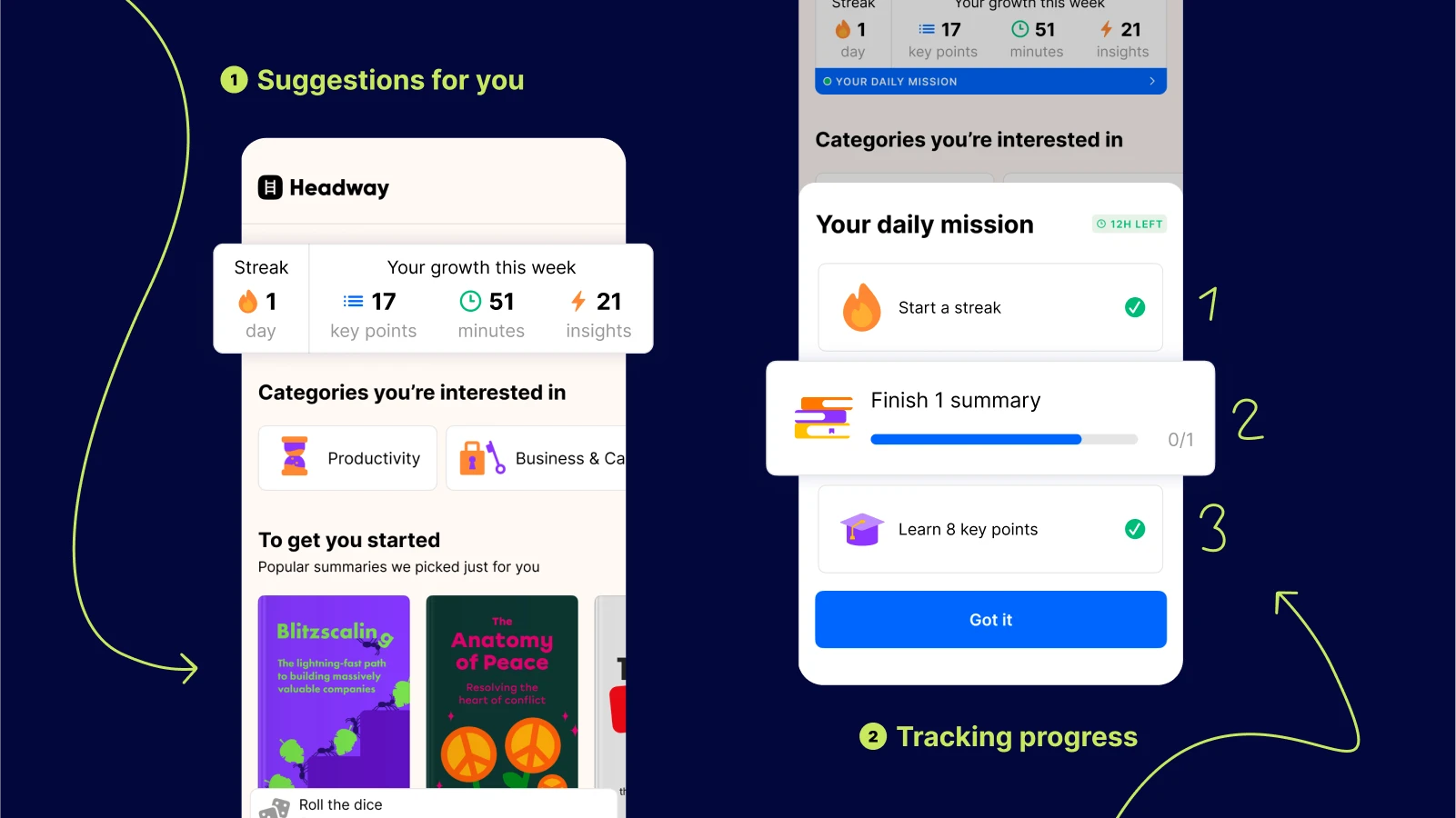
Then the gamification kicks in. Streaks. Flashcards built from your highlights using spaced repetition. 7-day and 30-day challenges with names like “The Modern Leader” that give you a sense of completion no raw library of books ever could. The product was engineered to create the daily habit first, and deliver the knowledge second — because without the habit, the knowledge never lands anyway.
This is the move Blinkist never fully made. Blinkist built a library. Headway built a ritual.
The business model underneath is equally counterintuitive.
Headway doesn’t spend conservatively on marketing. They spend aggressively — but differently. In 2024, their ads generated 7 billion impressions on Facebook and Instagram alone, bringing in 46 million new users. Not through brand campaigns or celebrity partnerships. Through thousands of AI-generated ad variations, tested and iterated until the conversion math worked.
Then, the moment a free trial user moves to cancel, the paywall offers a steep discount. The web subscription captures higher-value users while avoiding app store commissions. Every step of the funnel is engineered with the same quantitative obsession they apply to the product itself.
The result: profitable since 2020. Through a pandemic. Through a war. Growing.
And critically — $160 million in revenue built almost entirely before taking a single dollar of external funding.
For context, Blinkist raised $35 million before being acquired by Go1 in 2023. Headway built more than four times Blinkist’s estimated revenue while remaining bootstrapped. They finally took their Series A last July — not because they needed the money, but because they were ready to accelerate.
Here’s the part of the Headway story that matters most for anyone building a product in a crowded category.
They didn’t win by having better summaries than Blinkist. Honestly, on pure content quality, the difference is marginal. They won by understanding what the product was actually selling.
Blinkist sells access to a library. Headway sells proof that you’re the kind of person who keeps learning.
Those are different products for different psychological needs. One competes on breadth of content. The other competes on the daily feeling it creates. And the second one is significantly harder to replicate — because it’s not about what’s in the app, it’s about what the app makes you feel about yourself every morning when you open it.
A 12-day streak isn’t information. It’s identity.
That’s the GTM insight hiding in the Headway story. In categories with commoditised content — where every competitor essentially offers the same information — the winner is rarely the one with the most content. It’s the one who figured out what the content is actually a proxy for.
Ask yourself these three questions:
In your category, what is the product actually a proxy for? Not what it does — what it makes the customer feel about themselves?
Are you building a library or a ritual? One scales through content. The other scales through habit.
Could your product survive a war? Not metaphorically — what does it say about your unit economics if the answer is yes?
A Ukrainian engineer wrote a note to himself in a notes app on a December evening in 2018. Six years later, that note is a $160 million business — built through a pandemic, a war, and six years without external funding — because he understood that people don’t want to read more books. They want to feel like someone who does.
What surprised you most? The 90% revenue growth during the invasion? The 7 billion ad impressions with no brand budget? Or $160 million built before taking a single dollar of VC? Drop a comment — I’m curious what clicked.
Hey, I’m Deeksha. I currently work at Google as a Senior Product Marketing Manager and I study how Indian brands win without burning millions on ads — and break down what you can steal for your own business. Every week, I pick apart one company’s go-to-market strategy so you don’t have to guess what works.
Have a brand you want me to analyze? Drop me an email at behindthefeature@gmail.com
Come say hi on LinkedIn
Questions? Feedback? Hit reply — I read everything.